

Discovery Case Study: the Origins of Daraxonrasib
Topic: Hide on Homepage
We know that scientific progress doesn’t happen in a single moment. It moves step by step, from discovery to validation, pre-clinical development, clinical testing, and ultimately, patient access. But there’s another layer to that story, one that headlines often miss.

Even as we understand the pipeline process, critical questions remain: why do discoveries take so long to make their way through the progress pipeline? And just as importantly, what keeps good science moving forward?
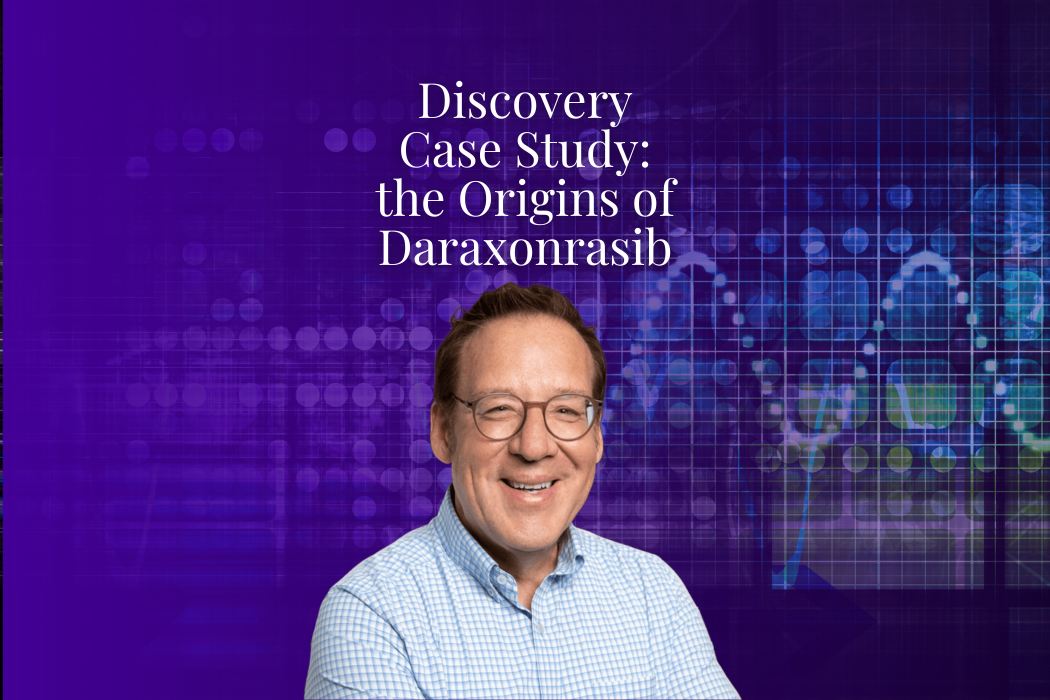
To answer that, we can look at the real-world experience of scientists working at the forefront of drug development. Enter Gregory Verdine, PhD, a Lustgarten-funded researcher whose scientific and entrepreneurial journey has helped redefine what is possible in targeting some of cancer’s most elusive drivers.
Dr. Verdine’s perspective offers a powerful lens through which to understand today’s progress in KRAS-targeted therapies for pancreatic cancer.
The “Undruggable”
KRAS was once thought to be the most notorious “undruggable” target in cancer. Identified as a major driver of human cancer in the 1980s, KRAS was known but not actionable. Its structure lacked the “binding pockets” that most drugs use to block a protein’s activity. Dr. Verdine explains an actionability gap where “no one knew how to drug them, and if you can’t drug them, you can’t shut them down, and if you can’t shut them down, the cancers just keep going.”
That gap would take over 25 years, and entirely new kinds of science, to close.
The Progress Pipeline in Action: From Concept to Clinic
Verdine’s work, beginning in academic labs at Harvard University and extending into biotech ventures such as Warp Drive Bio and later Revolution Medicines, focuses on drug invention, not just discovery. His team pursued entirely new ways to reach proteins once thought intractable. This work led them to develop a strategy to target active KRAS by using small molecules to recruit a natural cell protein, Cyclophilin A, to shut it down – a conceptual and technological leap that would take more than a decade to translate into clinical reality.
The idea came from observing how nature solved similar problems, “I was inspired by nature to say: if nature has done this, can I reverse engineer it,” Verdine recalls.
That strategy became the foundation for a platform that ultimately gave rise to multiple clinical molecules targeting different mutants and isoforms of RAS. “One of these, RMC-6236 [now known as daraxonrasib], was reported in 2025 to have exceptionally promising activity in treating pancreatic ductal adenocarcinoma and may represent the elusive breakthrough patients have so desperately needed,” Dr. Verdine reflected.
What began as a theoretical platform has become hope and real possibility for patients. Perhaps more importantly, this was not a single breakthrough moment. It was a progression across the full research ecosystem, each building on the last.
A Turning Point for Pancreatic Cancer
The first KRAS-targeting drugs to hit the market were based on a different chemistry than that pioneered by Dr. Verdine – one that allowed inhibitors of specific mutant KRAS proteins and targeted the inactive, or “off”, state of RAS. In 2021, the first KRAS G12C inhibitor, sotorasib, received FDA approval, followed by adagrasib, marking the first time any KRAS-driven cancers could be directly targeted with a drug. The G12C mutations targeted by these drugs are uncommon in pancreatic cancer, but the proof-of-concept was there. Targeting KRAS in pancreatic cancer was becoming a clinical reality.
But the field did not stop there. It expanded.
Across academia, industry, and government-supported research, more than 50 KRAS-targeted drugs are now in clinical development, spanning multiple mutations and protein states. This is “an incredible time in KRAS-driven disease,” remarked Dr. Verdine.
Nowhere is this momentum more consequential than in pancreatic ductal adenocarcinoma (PDAC), one of the most aggressive and treatment-resistant cancers. More than 90% of pancreatic cancers are driven by KRAS mutations, making this pathway not just relevant but central to advancing the treatment of the disease.
For decades, this dependency inhibited progress. Today, early clinical data are beginning to change that narrative. RAS(ON)-targeting therapies, including those emerging from the cyclophilin-assisted platform pioneered in part by Gregory Verdine’s work at Warp Drive Bio, are designed to target RAS proteins in their active “on” state — the form that directly drives cancer growth. This approach has demonstrated the ability to selectively target specific RAS mutations or broadly inhibit multiple known forms of RAS(ON), with promising early activity across multiple tumor types.
Most notably:
- Daraxonrasib delivered early clinical results that exceeded expectations, and Phase 3 data in second-line metastatic pancreatic cancer met key survival endpoints, including a near doubling of median overall survival, marking a pivotal validation of the pan-RAS approach.
- The FDA issued a “Safe to Proceed” letter to initiate Expanded Access Treatment Protocol (EAP), making it available as a second-line treatment option for patients with metastatic pancreatic cancer.
- While approval is expected in the second-line metastatic setting, ongoing studies are evaluating daraxonrasib as a first-line therapy to move its impact earlier in the treatment course.
- Zoldonrasib (RMC-9805) is a KRAS G12D–selective, RAS(ON) inhibitor that targets the most common KRAS mutation in pancreatic cancer. It is in early Phase 1 testing, showing encouraging preliminary anti-tumor activity and emerging as a key precision counterpart to pan-RAS strategies.
- RMC-5127 is a next-generation, oral RAS(ON) inhibitor designed to selectively target specific KRAS mutant subsets. It remains in early clinical development, with ongoing studies focused on safety, pharmacodynamics, and early signals of anti-tumor activity.
While still part of an evolving clinical story, these data are proof of a biologically targeted foothold, something pancreatic cancer has long lacked. And critically, that foothold is already reshaping the field.
Why It Took Decades: The Real Shape of Innovation
Dr. Verdine’s career underscores a central truth about biomedical innovation, that meaningful progress often requires the invention of entirely new categories of tools.
It was not enough to understand that KRAS caused cancer. Advancing the field required new ways of thinking about protein structure, new chemical modalities, new translational platforms, and sustained capital investment willing to tolerate long timelines and uncertain outcomes.
As he has emphasized, even “simple” questions, like how to turn a biological insight into a drug, often require 10–15 years of iterative invention and validation, with clinical development alone often taking 7 years or more.
The emergence of RAS(ON)-targeting therapies has helped energize the field by demonstrating the potential for more durable responses than earlier KRAS(G12C) “OFF”-state inhibitors, validating the importance of targeting the active, cancer-driving form of RAS itself. In this sense, breakthroughs are not isolated events, but convergences: the product of decades of scientific persistence, platform building, and sustained investment.
The Role of Foundations: Sustaining the Pipeline When the Path Is Unclear
Organizations like the Lustgarten Foundation play a critical role in sustaining the earliest and most fragile part of the pipeline: foundational research. As Verdine noted, “foundations punch far above their weight,” enabling discoveries that may not yet have obvious clinical applications but ultimately define entire therapeutic eras.
Lustgarten first funded Dr. Verdine’s work in 2013 through a project titled Targeting Ras using Cell-penetrating Mini-proteins. Nearly 15 years later, that early investment is beginning to translate into tangible progress for patients.
This long-view approach is not just supportive, it is catalytic. It allows researchers to pursue difficult problems like pancreatic cancer even when immediate feasibility is uncertain. It supports platform-building before products exist. And it ensures continuity in fields where scientific progress cannot be compressed into short funding cycles.
Without this type of sustained investment, many of today’s most promising therapeutic advances, including those now emerging in KRAS-driven pancreatic cancer, would not exist.
Looking Ahead
The current wave of KRAS-targeted therapies is more than a scientific milestone – it reflects a shift in what the field believes is possible.
With multiple clinical candidates advancing, emerging survival signals in pancreatic cancer, and expanding combination strategies on the horizon, the next decade is poised to build on a foundation laid over many decades before it.
And as history has shown, once momentum begins in a disease once thought untouchable, it tends not to stop, it accelerates. For pancreatic cancer, this is just beginning.