


New Report: ACS Cancer Facts & Figures 2026 report five-year relative survival rate for pancreatic cancer remains at 13%
Topic: Hide on Homepage, News, Pancreatic Cancer News, Your Source for Breaking News & Inspirational Stories
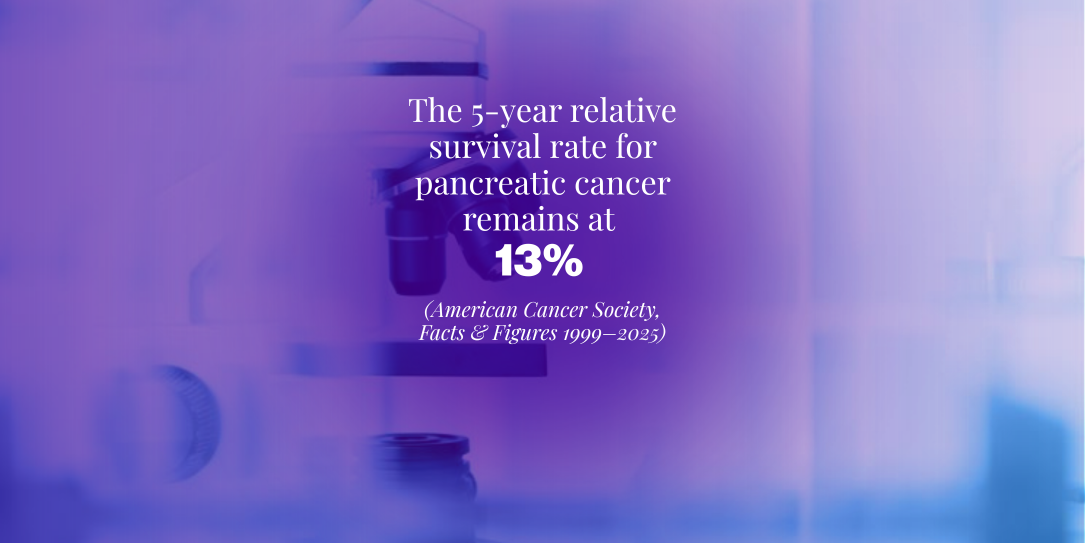
The American Cancer Society has released its Cancer Facts & Figures 2026—and for pancreatic cancer, the story is not one of progress. It is an alarm we can no longer ignore.
The five-year relative survival rate remains stuck at just 13%. Incidence continues to rise. And for tens of thousands of families, the outcome remains heartbreakingly predictable.
In 2026 alone, an estimated 67,530 Americans will be diagnosed with pancreatic cancer. Approximately 52,740 will die. Pancreatic cancer is now the third leading cause of cancer-related death among both U.S. men and women—behind only lung and colorectal cancers—despite accounting for just 3% of all cancer diagnoses.
This crisis has been building for decades.
- Incidence has increased by about 1% per year since the 1990s
- The five-year survival rate has shown no meaningful improvement year over year
- Only 17% of patients are diagnosed at a localized stage, where five-year survival is 44%—a figure that has also remained largely unchanged
While overall cancer death rates in the United States continue to decline, pancreatic cancer has been left behind. Late diagnosis, limited effective therapies, and chronic underinvestment in research mean most patients are diagnosed with too little time—and far too few options.
This is unacceptable.
These statistics demand more than attention. They demand urgency: more innovation, more resources, more treatment options, and more time for patients. Pancreatic cancer patients cannot wait for incremental progress. With survival flatlined year after year, the need to accelerate bold, transformative research has never been clearer.
That is why the Lustgarten Foundation remains steadfast in its mission to change the trajectory of this disease. We are advancing the most promising science across early detection and interception, therapeutic development, and personalized medicine—areas where progress can fundamentally alter outcomes and quality of life.
At the forefront of this effort is ourLABS (Lustgarten Advancing Breakthrough Science) Program, which provides sustained, long-term funding to fuel high-risk, high-reward ideas, accelerate discovery, and bring interdisciplinary teams together to tackle the hardest problems in pancreatic cancer. Across our broader research portfolio—including the Innovation and Collaboration Program, Lustgarten Equity, Accessibility, and Diversity (LEAD) Project, Clinical Accelerator Initiative (CAI), and Therapeutics-Focused Research Program—we are moving with focus, rigor, and speed to deliver impact where patients need it most.
“This year’s ACS Facts & Figures report underscores our responsibility to do better for pancreatic cancer patients and their families,” said Linda Tantawi, CEO of the Lustgarten Foundation. “An estimated 185 people will be diagnosed today—and every day this year. They deserve more options, more time, and real hope. Together, we have the power to accelerate progress and deliver life-saving breakthroughs.”
But philanthropy alone is not enough. To deliver the breakthroughs patients urgently need, pancreatic cancer research must receive greater and sustained federal funding that reflects the disease’s disproportionate mortality. Policymakers must act, so scientists have the resources to accelerate discovery, expand clinical trials, and save lives.
The data are clear. The stakes could not be higher.
Patients deserve MORE—and they deserve it now.
Join us. Advocate. Give. Help transform pancreatic cancer into a curable disease.