


The Power of Persistence: Ecosystem Thinking and Career Leadership in Cancer Research
Topic: Hide on Homepage, News, Pancreatic Cancer News, Press Releases
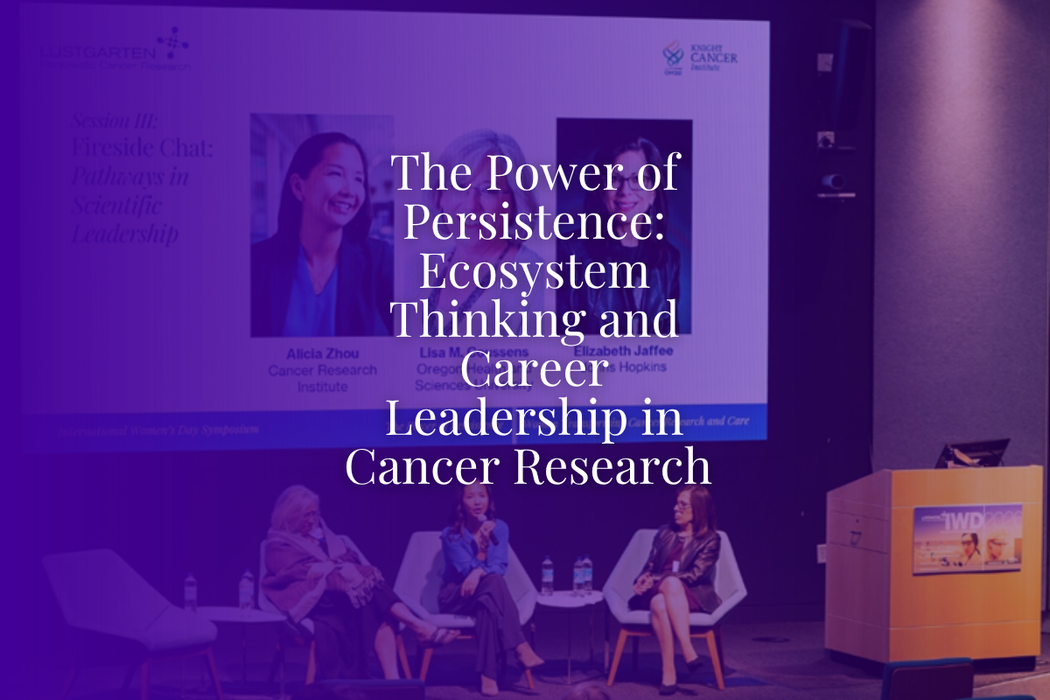
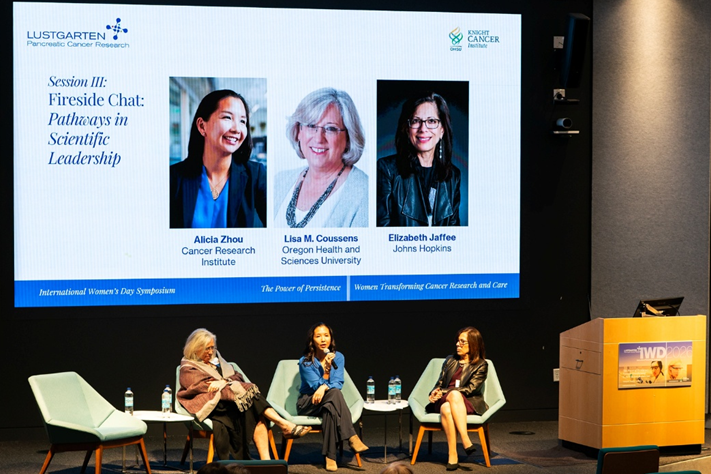
The Lustgarten Foundation’s annual International Women’s Day symposium, The Power of Persistence: Women Transforming Cancer Research and Care, highlights women’s critical role in advancing innovation in the fight against cancer. Co-chaired by Lisa Coussens and Elizabeth Jaffee, the event celebrates women’s achievements while fostering collaboration, mentorship, and the exchange of ideas, providing a platform where shared experiences, the challenges alongside the successes, forge lasting connections that contribute to the continued advancement of cancer research and care. One session brought Coussens and Alicia Zhou, CEO of the Cancer Research Institute, into conversation with Jaffee as moderator. What followed was a candid exchange about scientific integrity, leadership, and the values that hold a career and a scientific community together.
The Illusion of a Linear Path
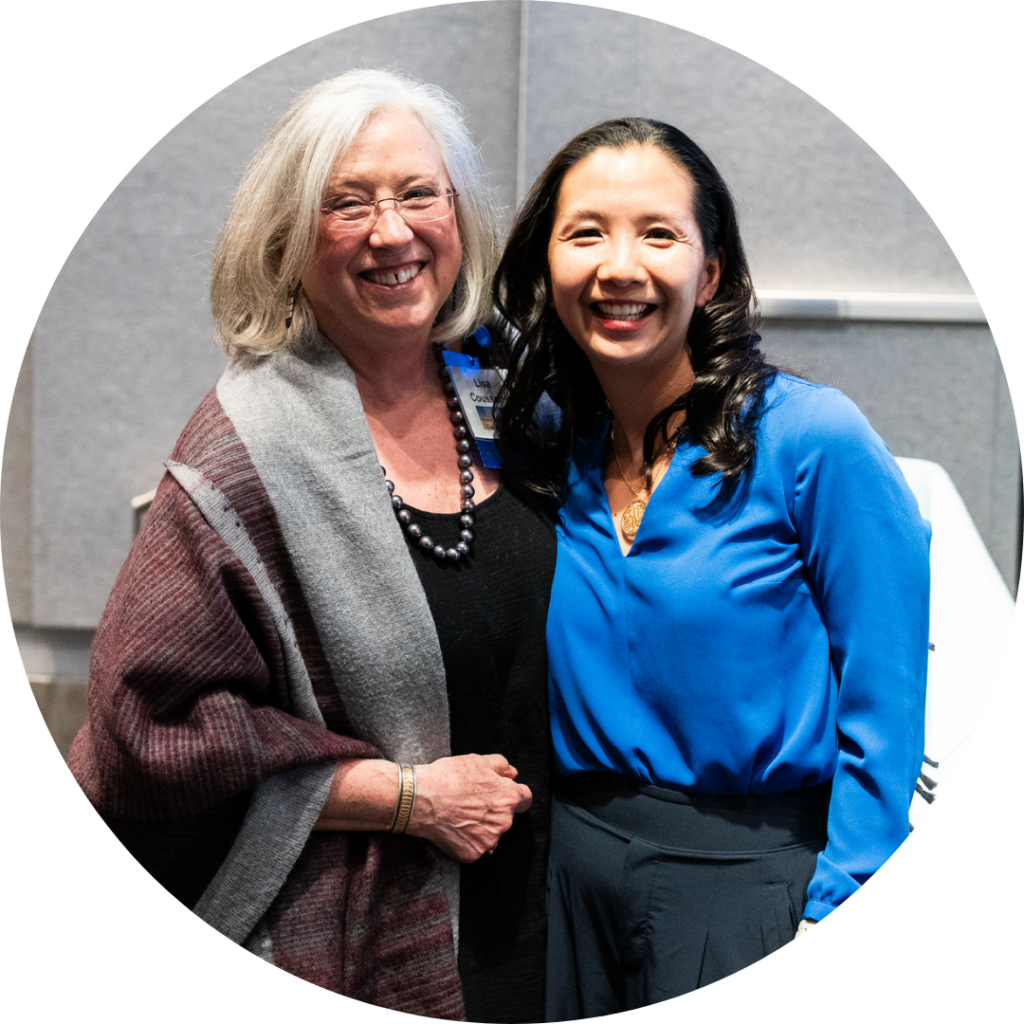
Neither Coussens nor Zhou arrived at their current positions by design. Coussens began her scientific life as a marine biologist, took a job washing dishes at a then-nascent Genentech because the fine print specified no particular qualifications required, and was taught molecular biology by Axel Ulrich, a trailblazing biochemist who helped shape modern cancer treatment, at a moment when the field itself was being invented. Zhou grew up on university campuses, assumed she would follow her parents into academia, and left a postdoc to join a 30-person startup without a full-time offer or benefits because the opportunity felt worth the uncertainty.
What mattered most wasn’t what they planned, but what they did when faced with the unexpected. “Jumping into the unknown sometimes is the very best decision you can make,” Coussens said. Zhou put it differently: “I’ve always been able to embrace opportunity when it’s made itself available to me.” Neither was describing recklessness, but instead conveyed a hard-won confidence in their own judgment: that whatever was on the other side of the door, they would figure it out.
“When you look backward, hindsight is 20/20,” Zhou said. “You can find a linear path that tells your story. It’s the same way you write your papers; you look at your data backward, and you’re like, yeah, that’s what I was going for. That’s also true about career.”
What You Are Optimizing For
Zhou’s decision to leave academic science came from principled reflection, not a career calculation. When she stopped her experiments to have her son, pausing her grant, freezing cells, culling mice, she was struck by a disquieting thought: no one cared as much as she did that her science had paused. She found herself wondering whether she was working on anything truly impactful, whether “the person who was most impacted by me pausing my work was, was just me.”
That question, asked honestly, changed everything. She left not because she had a plan but because she had a conviction: that she wanted her work to matter beyond herself. Academic science at the time felt more like an individual sport than a team sport, and she was interested in what was on the other side.
Coussens arrived at a similar reckoning through grief. Walking with Zena Werb, a pioneering cell biologist at UCSF and one of the most formative mentors of her career, in Madrid shortly after her brother’s death, she found herself thinking about what he had said to her the morning he died: the things he was regretful of, the things he hadn’t done. “When I die, I want to be really proud of what I did and what I accomplished, but more importantly, I want to be proud of the impact that I had.” The opportunity to build a cancer biology department at Oregon Health & Science University (OHSU) from scratch was not a career move; it was an answer to that question.
Both women were explicit about what they were not optimizing for. Don’t do it for money, Coussens said. Don’t do it for a title. “They’re cheap. Anybody will give you a title. It has to add value to what you’re doing.”
Indecision Is a Decision
Zhou applied the logic of experimental design to the problem of career uncertainty.
“You are constantly already testing the null hypothesis,” she said. “That’s the life you have right now. If you want to make a change, that’s you choosing a different hypothesis. But don’t be lulled into a sense of like, oh, you have all this potential choice — when in fact you are making a choice, and time is costly.”
The conventional wisdom around career transitions emphasizes optionality: keeping doors open, waiting for the right moment, gathering more information before committing. Zhou makes the point that this contains a hidden assumption, that not deciding is neutral. It isn’t. Staying in the current position is a choice with a cost, and the cost compounds with time. Every month spent deliberating is a month of the status quo, which is itself a data point about what the status quo produces.
This is not an argument for recklessness. It is an argument for honesty about what deliberation actually is. When you are weighing a major transition, you are not standing outside the experiment. You are already running it. The null hypothesis has results accumulating in real time.
“You know when you know,” Coussens said. “And if you don’t know, it’s not the right decision.”
Ecosystem Thinking as Leadership Philosophy
Coussens has thought in systems throughout her career. It began in tide pools. “Coming from marine biology, what was really clear to me was that it was the ecosystem that mattered,” she said, “not the starfish, not the single species of algae, not the rock, not the sea urchin, but the community.”
It carried into her scientific work, where she became one of the first researchers to systematically study the immune cells recruited to the tumor microenvironment during neoplastic progression, work that an advisor initially warned her was “career suicide.”
“Biology doesn’t tell me that,” she said. She followed her gut. Werb became a lifelong collaborator, and together they spent decades demonstrating that the cells surrounding a tumor are not bystanders but participants, a finding that has since become foundational to the field.
That choice reflected a deeper ethical commitment. Following the biology, even when it contradicted prevailing wisdom and put her career at risk, was not only a matter of scientific conviction; it was a matter of integrity. “Go with your gut,” she said. “It has failed me once, but scientifically, never.” And when she was wrong, which she acknowledged happened, the commitment held. It was Werb who had taught her that: “You have to be willing to be wrong. Be careful how you plan your experiments, but learn something even if you are wrong.” The willingness to be wrong is not a concession. It is a scientific value, and for Coussens it is also a moral one. Science has an obligation to follow the truth wherever it leads, independent of whether the path is professionally safe or institutionally convenient.
The same orientation carried into how she built her department and led people. The promise she made to every faculty member she recruited, that she would always have their back no matter what, was not a management strategy. It was a moral commitment. When you recruit people into a program you are building, you owe them the conditions to succeed. Thirteen years later, the program had returned 367% on its original investment. But the metric she was most proud of was not financial. It was the trainees who had moved through the department and the collaborative culture that made their success possible.
“The most joy I have is truly the success of every one of your labs,” she said. “That has been the most gratifying thing. I will die happy because this worked.”
When asked to create that department, she thought about building an ecosystem, not merely assembling talented individuals. She researched startup packages for junior faculty nationally. She identified the critical mass, ten to fifteen faculty, required to produce a functional scientific community rather than a collection of siloed labs. She wrote a vision statement and negotiated with clear knowledge of what was institutionally possible and where she could push.
Mentorship followed the same logic. When Werb responded to Coussens’s early questions about tumor-infiltrating leukocytes with “why don’t you figure that out?” she was not deflecting. She was practicing a form of mentorship that trusts the person being mentored to find the answer. “That truly was the very best mentorship I’ve ever gotten,” Coussens said, “because she empowered me at each step along the way.” Coussens built her department around the same principle: knowing she had people’s backs, creating conditions for their success, and measuring her own achievement by theirs.
A Different Model of Leadership
Zhou was explicit about her ambivalence toward the leadership roles she has taken. Ten years ago, if someone had asked her whether she wanted to be a CEO, the answer would have been immediate: no. “There are so many decisions to be made and so many responsibilities — and what if you don’t know what you’re doing?”
What changed was not her ambition, but her understanding of what leadership could look like. When the Cancer Research Institute approached her, she turned the recruiter down. What brought her back was a question about whether a different kind of CEO was possible, one whose model didn’t fit the paradigms she had observed.
“There are many male paradigms of leadership,” she said, “and often those tend to come from the front — the person at a podium speaking out and down: here’s my vision, go execute.” What she was interested in was a coach-player model, in which the leader works alongside the team, in which authority is expressed through trust rather than direction.
The model has direct implications for hiring, and those implications are grounded in something more than strategy. High standards in hiring are an act of stewardship: toward the mission, toward the team, and toward the people who will work alongside the person hired. “When I would start interviewing,” she said, “I started as a 3, meaning you would come into the door, and I would assume I was hiring you. Today, you walk in that door, I’m starting out as a 2. I’m not hiring you. At some point in this interview, you’re going to convince me I should hire you. If you don’t do it, then you don’t do it.” She also hires with explicit attention to succession. “You should always be looking to hire the person who could replace you,” she said, attributing the advice to an early manager. “If they can replace you, then you can go do something else. That’s how you grow.”
Environments that reward individual expertise and visibility resist this logic. But hiring someone who can do your job isn’t making yourself redundant; it’s creating the space to grow beyond it.
When the team at Color Health grew from 150 people to ~1,000 in two years, then contracted again after the pandemic, she learned under pressure what delegation actually requires: not a loosening of standards but a sharpening of them, combined with genuine trust in the people hired to meet them. “My job is not to tell you what to do. My job is to get out of your way.”
On Saying No
Both women described saying no as among the hardest things they had learned to do.
Coussens noted that when she had asked Werb how to decide when to say no, Werb had promised to tell her when she could, adding: “She died and I still don’t have an answer.” The question of how to allocate finite time and attention is not a problem that gets solved. It gets managed, imperfectly, in perpetuity.
“When I say no, I always make sure I have a name ready for someone else that’s better positioned than me to do that, whatever that is,” Coussens said. “And I’m careful with how I say no — I provide a little bit of context, so people don’t just go, you could have done that.” The goal is to remain useful even in declining.
Zhou offered a practical reframe: “Instead of saying no, you’re saying not right now.” A no closes a door. A not right now leaves it open, signals continued interest and creates the conditions for a future yes. Even a genuine permanent no can be delivered as not me, but this person instead, transforming a refusal into a referral.
Both approaches rest on the same understanding: that the scientific community is an ecosystem, that relationships within it have long time horizons, and that how you decline matters.
Persistence as Practice
The title of the Lustgarten Foundation’s symposium, The Power of Persistence, is not incidental. What Coussens and Zhou described is persistence in its least glamorous form: not the refusal to quit, but the daily practice of staying oriented toward what matters while adapting to what changes. Persistence as the willingness to follow the biology even when your advisor warns you against it. Persistence as the willingness to be wrong, to learn from it, and to keep going. Persistence as hiring well, trusting the people you hired, and measuring your success by theirs.
Zhou framed the core question in terms of time: “Life is relentlessly moving in one direction. You never get to redo any day or any year. So, if you’re going to spend this amount of time — let it be something you’ll be proud to have worked on.”
This essay is drawn from a moderated conversation at the Lustgarten Foundation’s The Power of Persistence: Women Transforming Cancer Research and Care symposium. The session was moderated by Elizabeth Jaffee, Deputy Director of the Sidney Kimmel Comprehensive Cancer Center at Johns Hopkins University. Panelists were Lisa Coussens, Hildegard Lamfrom Endowed Chair in Basic Science, Professor and Chair of the Department of Cell, Developmental & Cancer Biology at Oregon Health & Science University, and Alicia Zhou, CEO of the Cancer Research Institute.
Watch the full symposium here.