


The System that Delivered the Possibility of mRNA Cancer Vaccines is Being Dismantled
Topic: Hide on Homepage, News, Pancreatic Cancer News, Press Releases
For years, pancreatic cancer has been considered immune to immunotherapy. Its tumors were “cold”—invisible to the body’s natural defenses and resistant to treatments that worked against other cancers. Patients had fewer options and less hope.
Then Dr. Vinod Balachandran at Memorial Sloan Kettering asked a different question: What if pancreatic cancer wasn’t actually invisible to the immune system? What if it just needed the right signal?

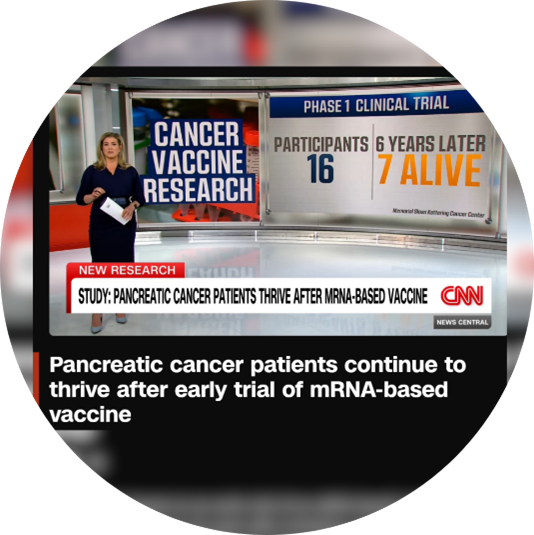
His team began studying rare long-term survivors whose immune systems appeared to be doing something unusual—developing strong responses against unique mutations in their tumors. That insight became the foundation for personalized mRNA vaccines that are now making national headlines, showing remarkable results in helping patients avoid recurrence after surgery.
This breakthrough represents everything that works about strategic research investment. The Lustgarten Foundation recognized the potential years before it made news, funding the work when it was still considered a long shot. The results, published in Nature in 2023 and now generating widespread attention, prove that sustained investment in bold science can change what’s possible for patients with devastating diseases.
It also shows exactly what we’re now putting at risk.
THE NUMBERS DON’T LIE
Even as federal research grants have begun to flow again in recent weeks, the damage from the past year’s chaos is both measurable and severe. The numbers tell a story of systematic disruption to the research infrastructure that makes breakthroughs like Balachandran’s possible.
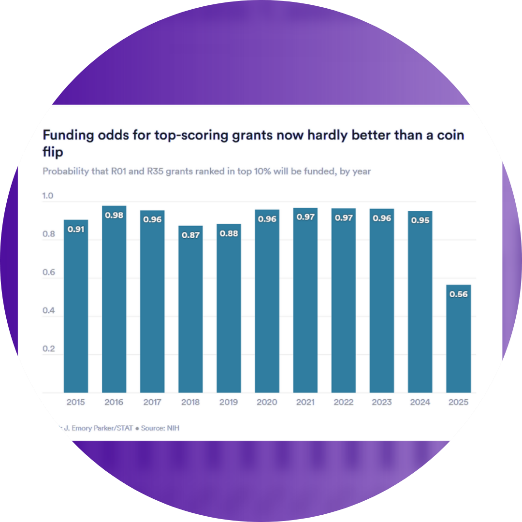
Just 13% of NIH applications were funded in the past fiscal year, the lowest success rate in the agency’s history.4 At the National Cancer Institute, success rates for grant applications have plummeted from 1-in-10 to 1-in-25. Even proposals that scored in the top 10% had only a coin flip chance of being funded in 2025.5 The agency has fallen about $1 billion behind its typical timeline for awarding grants, affecting research on cancer, heart disease, Alzheimer’s disease, and other critical areas.
As of late April, NIH had spent only $8 billion of its $47 billion budget—30% less than average spending at the same point from 2021-2024.6 The agency posted only 125 funding opportunity notices in 2025 versus 756 in 2024, and just 14 so far in 2026.7 The human toll has been equally devastating. In early 2025, NIH terminated 2,291 active research grants, withdrawing $2.45 billion and disproportionately affecting women and early-career investigators. Among assistant professors, the researchers building the careers that will drive breakthroughs in the 2030s and beyond, 59.8% of terminated projects were led by women. The $2.5 billion in canceled grants translated to roughly $6.3 billion in lost economic output.
A recent STAT survey of nearly 1,000 NIH-funded researchers revealed the practical impact: 45% had grant starts delayed, 29% said applications didn’t go through the full review process, and 32% reported that their grant programs had been terminated entirely over the past year.8 Three in four researchers applied for alternative funding sources, but only 21% received additional support.9 When asked to describe impacts on their labs, one in five researchers expressed fear, uncertainty, low morale, or stress.10
These aren’t abstract statistics. They represent the research workforce that will solve tomorrow’s medical challenges, develop next-generation treatments, and translate scientific discovery into clinical reality.
EXPERTISE, DISCARDED
The most shocking example of institutional degradation came on April 25, when the White House dismissed the entire National Science Board with a terse email providing no explanation.1 The 25-member independent board, which oversees NSF’s $9 billion research portfolio, normally serves staggered six-year terms specifically to ensure continuity across political transitions.
While the White House later cited a 2021 Supreme Court decision about non-Senate confirmed appointees, the practical effect is devastating: NSF now has no board, no permanent director, and no deputy director.2 The agency’s staff has fallen by about 35% from last year, and it plans to “consolidate” grant solicitations to half the usual number of funding opportunities.3
The administration had proposed a 55% cut to NSF’s budget, but Congress rejected the proposal and maintained funding at 2025 levels—demonstrating the bipartisan political will to support scientific research that contrasts sharply with the administrative chaos.
This represents something more destructive than funding cuts or administrative delays. It’s the deliberate elimination of institutional expertise that took decades to accumulate. These board members didn’t just oversee grant decisions they provided strategic guidance, identified emerging opportunities, and ensured that research investments aligned with national priorities. That knowledge walked out the door in a single afternoon. NSF has awarded new grants at the slowest pace in at least 35 years. Administrative bottlenecks and staffing challenges have left fewer personnel available to process grants, creating a cascade of delays that affect researchers nationwide.
THE TALENT DRAIN
The pattern has become disturbingly familiar: projects approved by scientific review panels but never funded due to administrative chaos and budget uncertainty. The administration canceled 22 separate mRNA research contracts, including work on vaccines for pediatric cancers. Researchers who had received approval found themselves scrambling to maintain their labs and redirect their careers.
This captures a crucial point about research infrastructure. The damage isn’t just about delayed projects or reduced funding levels, it’s about the talent we’re losing and the institutional relationships we’re destroying. When promising researchers leave science, when training programs shut down, when collaborative networks dissolve, the effects compound over decades.
The postdoc who leaves science today would have been leading a lab in 2030. The assistant professor whose funding disappears won’t be there to mentor the next cohort of researchers. The senior scientist who takes early retirement takes with them decades of accumulated expertise about what works, what doesn’t, and how to navigate complex research challenges.
WHEN THE SYSTEM WORKED
Balachandran’s mRNA vaccine success demonstrates what becomes possible when the research ecosystem functions as designed. The Lustgarten Foundation provided strategic early investment, recognizing the transformative potential before it was widely accepted. Federal funding supported the basic research infrastructure that made mRNA technology possible. Academic medical centers provide clinical expertise to test and refine the approach. Industry partners brought the resources to scale promising discoveries.
The results speak for themselves. Patients who mounted strong immune responses to the personalized mRNA vaccine were significantly less likely to see their cancer return. Some participants maintained active immune responses for nearly four years. For a cancer where recurrence rates remain devastatingly high, this represents a fundamental shift in what’s possible.
But this success required more than scientific insight. It demanded sustained funding, institutional stability, and the research infrastructure that allows discoveries to build on each other across institutions and decades. The current disruptions represent the loss of these capabilities.
WHAT WE’RE THROWING AWAY
At the Lustgarten Foundation, we understand this ecosystem dynamic in all its complexity. As the largest private funder of pancreatic cancer research in the world, our investments succeed because they leverage the broader federal research infrastructure. We make strategic early investments in breakthrough science, but those investments multiply when they connect to sustained federal support for basic research, training programs, and institutional capacity.
When that infrastructure becomes unreliable, even the most strategic private investment loses effectiveness. Foundation funding cannot replace the scale and stability that federal investment provides.
Federal research funding consistently generates $2.57 for every dollar invested, supporting nearly 400,000 jobs and creating $94 billion in economic activity annually. But the economic argument, while compelling, misses the deeper point about research infrastructure. The breakthroughs that define medical progress, from mRNA vaccines to targeted cancer therapies to diagnostic advances, emerge from decades of accumulated knowledge and institutional capacity.
You cannot rebuild that capacity quickly once it’s lost. The expertise that guides strategic decisions, the relationships that enable collaboration, the institutional memory that prevents costly mistakes—these take decades to develop and can disappear in an afternoon.
THE NEXT CRISIS
Even as some federal funding has begun to resume, the past year has exposed dangerous fragilities in the research system. What happens the next time political priorities shift? How do we maintain the long-term thinking that breakthrough innovation requires when institutional expertise can be dismissed without explanation?

“When you lose institutional memory and eliminate the expertise that guides strategic decisions, you undermine our ability to translate discoveries into treatments,” said Dr. Elizabeth Jaffee, Chief Medical Advisor at the Lustgarten Foundation. “The research enterprise depends on stability and predictability. Without that foundation, promising discoveries may never reach the patients who need them.”
The children and adults facing devastating cancers deserve research systems that can deliver on their promises. The next generation of researchers whose careers were derailed may never return to science. The institutional knowledge that walked out of federal agencies won’t be easily replaced.
For pancreatic cancer patients, time is everything. Time to access effective treatment, to watch children grow up, to plan for futures that too often feel uncertain. Balachandran’s breakthrough changes what patients can imagine for themselves, not just new treatments, but new categories of possibility.
That’s what strategic, sustained investment in research infrastructure makes possible. Not just solutions to today’s challenges, but the capacity to respond to tomorrows with the speed and effectiveness that breakthrough innovation requires.
We know how to build research ecosystems that deliver transformative results. Medical research and cancer research command overwhelming public support across party lines. Recent polling shows that 74% of voters support federal investment in scientific research, with more than 8 in 10 Americans believing it’s important for the United States to be the global leader in scientific research and technology.12 Support for NIH funding has actually increased during the current administration: more than 90% say it’s important for the U.S. to lead in medical research, with only 8% saying the government spends too much on research.13
Congress demonstrated this popular will by rejecting the administration’s proposed 55% cut to NSF and maintaining NIH funding at previous levels despite White House pressure.11 The question is whether our political system can maintain the sustained investment that breakthrough science requires despite administrative hostility to the institutions that make it possible.
UPDATE: September 1, 2026
CONGRESS TEMPORARILY BLOCKS EFFORT TO POLITICIZE FEDERAL RESEARCH GRANTS
The Lustgarten Foundation’s commitment to sustained research funding is what produced daraxonrasib, a treatment now extending the lives of pancreatic cancer patients after more than a decade of investment. That same stable, long-term funding was at stake in Washington this summer, and while we won a battle, the war isn’t over.
You called. You emailed. You told your representatives that research funding matters to you and to the patients you love. And Congress listened.
On Tuesday, the House passed a stopgap government-funding bill 370-48, with a provision that temporarily blocks the White House proposal to give political appointees control over federal research grants.27 The Senate had already approved the same bill a month earlier;28 it now heads to the president’s desk. The overwhelming, bipartisan margin reflects just how unpopular the proposal has been. A public comment period on the rule drew opposition from 95% of respondents, spanning life sciences researchers, universities, and defense contractors alike.29
the reprieve is temporary
The bill funds the government only until December 11, and the ban on the grant-overhaul policy expires the same day. That sets up another fight at year’s end, this time during a lame-duck session after the midterm elections.
Senate Appropriations Committee Chair Susan Collins has said she will keep fighting to make the ban permanent. Not everyone in the Senate agrees. Sen. John Kennedy of Louisiana has vowed to fight just as hard for the administration’s original proposal. And OMB Director Russell Vought, who authored the policy, has said he does not plan to implement it until December regardless, meaning the temporary ban does little to slow his timeline.
There is also the question of enforcement. Even if Congress makes the ban permanent, the administration could choose not to follow it. Last year, the administration delayed and withheld billions of dollars in congressionally approved research funding before NIH ultimately spent its full budget. A law on the books is not the same as money reaching a lab.
this isn’t over
The version of this fight that matters most is still ahead: getting a permanent ban included in the year-end government funding bill, before political appointees can take control of how research grants are awarded. That fight will happen in the weeks after the midterms, when attention is divided and it is easier for a provision like this to quietly disappear.
If you called your representatives this summer, thank you. If you haven’t yet, this is your moment. The fight isn’t finished, and it will be decided by December. We need you again.
call or email your senators and representative
“Thank you for supporting the temporary ban on political control of federal research grants. This policy would undermine peer review and make it harder for scientists to pursue long-term research. I’m asking you to make this ban permanent in the year-end government funding bill in December, before political appointees gain control over how research dollars are spent.”
Find your representatives at congress.gov.
UPDATE: July 6, 2026
Three developments since our last update, a new word-screening process for NIH grants, deep cuts to NSF’s basic research programs, and a second straight year of declining Ph.D. admissions, show what is at stake for the pipeline of research that pancreatic cancer patients depend on.
A WORD LIST INSIDE NIH
According to an investigation by Nature, NIH has built an algorithm that screens every grant application for 235 terms the agency has deemed out of step with administration priorities, including “gender,” “climate change,” “racism,” and “sexual minorit,” a stem meant to catch any form of the phrase “sexual minority.”23 The screening happens after applications have already cleared two rounds of peer review and been judged worthy of funding by program officials and institute directors.
Applications flagged by the algorithm are marked “not clean.” Program officers are then told to renegotiate the language or scope of the project with the applicant, or drop it. Before 2025, it was unheard of for a grant that had cleared outside peer review to be rejected at this stage, an NIH official who has worked at the agency for years told Nature.
The delays are substantial. Most applications clear this additional review within two weeks, but 10% of grant-renewal applications that entered the process in fiscal year 2026 have been stuck for more than seven weeks, and some indefinitely. An NIH spokesperson told Nature there is no “banned word” list and that funding decisions are not based on specific words or phrases. Internal documents reviewed by Nature show that applications using the flagged terms are substantially more likely to be pulled aside for additional review by NIH and Department of Health and Human Services officials.
“We’re the test case,” one NIH program officer told Nature, noting that the OMB rule now under public comment would extend this kind of review across the government. “The new rules would essentially codify the administration’s ability to restrict funding on anything because they don’t like the topics or the words.”
nsf CUTS BASIC RESEARCH TO FUND A NEW INITIATIVE
NSF has cut budgets for hundreds of its traditional basic science programs by 20 to 30 percent this fiscal year, even though the agency’s overall budget fell by only 3 percent.24 The result is a sharp drop in new grants across nearly every field NSF supports, from mathematics to earth sciences to the social and behavioral sciences.
NSF has not publicly explained the cuts. Sources inside and outside the agency believe the funds are being redirected to a new $1.5 billion initiative called X-Labs, which will fund a small number of teams working on applied technology rather than the curiosity-driven basic research that has traditionally defined NSF’s mission. An internal memo from a unit within NSF’s math and physical sciences directorate told program managers their budget for the year had been cut 30% from 2025 levels and instructed them to “pull back any award recommendations in the queue.” The memo asked staff not to tell applicants and grantees about the change. The biology directorate lost $200 million on top of that.
Julia Phillips, a former member of the National Science Board that was dismissed in April, told Science the shift compounds an already reduced base. “NSF’s mission is to support discovery research, which is also the basis for any new technology,” she said. “This sudden change in direction reflects a total lack of understanding of how science is done.” Fewer grants, across more fields, with less explanation: the pattern is consistent with what NIH and NSF have both done all year.
WHAT RESEARCH ACTUALLY RETURNS
The pattern of disruption is easier to weigh against what sustained federal research investment has produced. The government’s $3.8 billion investment in the Human Genome Project generated an estimated $796 billion in economic output, a return of roughly 141 to 1. Basic research supported by NSF and other federal agencies has returned between $1.50 and $3.00 for every dollar invested since 1950, according to Federal Reserve estimates.25
That return depends on a pipeline of scientists willing to spend a career on hard problems. That pipeline is now shrinking.
PH.D. ADMISSIONS FALL FOR A SECOND YEAR
New Ph.D. admissions dropped 15% this fall at more than 50 top research universities, on top of an 11% decline the year before.26 Together, two years of data point to what the Association of American Universities calls a substantial reduction in the number of doctoral students entering the country’s research pipeline. Those universities confer half of the nation’s research doctorates.
University leaders point to the same cause repeatedly: unpredictable federal funding. The administration proposes deep cuts, Congress restores some of the money, and the money still does not arrive on schedule. MIT’s president, Sally Kornbluth, said in a message to campus in May that new federal research awards were down 20% even after Congress restored funding. The money, she said, was “not actually flowing to MIT the way it typically has,” according to The New York Times. The California Institute of Technology is cutting its incoming graduate class by 40% for fall 2026, citing funding uncertainty rather than any specific cut. The University of Washington’s astronomy department chair decided not to admit any new doctoral students this year for the first time in her tenure.
“We are at risk of losing a whole generation of new talent because of the reduction in the capacity to support those students,” Toby Smith of the Association of American Universities told The New York Times.
Applications from international students fell 21% even as domestic applications rose slightly, a decline researchers attribute in part to visa delays and travel restrictions. Association officials note that competitor nations, including China, are actively recruiting the students the United States is turning away.
A graduate student trains for years before contributing independent research. A lab that admits no students this year has no fifth-year researcher in 2031. As Kornbluth told the Times: “When you shrink the pipeline of basic discovery research, you choke off the flow of future solutions, innovations and cures, and you shrink the supply of future scientists.”
YOU CAN HELP
Congress has repeatedly shown it will defend research funding when constituents speak up. The OMB proposal is open for public comment through July 13, but direct contact with your representatives is equally important.
Call or email your senators and representative:
“I’m calling to express my strong support for federal investment in medical research. Recent proposals to give political appointees control over scientific grants would undermine the peer review system that has made American research the world leader. I urge you to oppose any efforts to politicize research funding and to maintain robust support for NIH, NSF, and other research agencies. Medical research saves lives and drives economic growth in our state.”
Find your representatives at congress.gov.
Share this with friends and family. Ask them to call too.
UPDATE: June 9, 2026
Recent developments show how political interference continues to threaten the research infrastructure that enables medical breakthroughs.
The story of daraxonrasib shows what strategic research investment can achieve. For over a decade, the Lustgarten Foundation funded Gregory Verdine’s work targeting KRAS, the “undruggable” protein that drives pancreatic cancer in 90% of patients. That patience paid off. Two weeks ago at ASCO, daraxonrasib data showed a near doubling of median overall survival in pancreatic cancer patients.19
The research infrastructure that enabled this breakthrough now faces systematic political control.
Political Appointees Gain Veto Power
A new Office of Management and Budget proposal would place political appointees in control of federal research grants.20 The proposal treats scientific peer review as “advisory” and requires political appointees to conduct “pre-issuance review” to ensure grants advance the president’s policy priorities.
Grants could be terminated if work “no longer effectuates program goals, federal agency priorities, or the national interest.” The proposal specifically targets diversity research, studies involving gender transition for people under 19, and work that challenges “the biological reality of sex.”
“What OMB is proposing is not a reform of grants management. It is a complete political control apparatus layered over every stage of the federal science funding lifecycle,” wrote Elizabeth Ginexi, a former NIH program official.21
UNIVERSITIES UNDER PRESSURE
The political interference extends to documented targeting of specific institutions. The Trump administration has quietly slowed funding for research at Harvard, Duke, Princeton, and Yale.22 More than 40 grants worth $35 million were placed on hold at these universities, with no clear pattern in the type of research being delayed.
Mathematics professors at Harvard reported waiting months for word on proposals involving geometry and algebra. After The New York Times inquired about the slowdown, NSF began releasing some funding within days.
As of May 1, NSF had committed only 10% of its congressionally appropriated funds, half of what the foundation typically awards by this point.
INFRASTRUCTURE UNDER ATTACK
These developments target the institutional stability that breakthrough science requires. Verdine’s daraxonrasib work needed sustained investment, predictable funding cycles, and freedom to pursue difficult problems without immediate applications. That took more than a decade of patient capital.
When peer review becomes “advisory,” when grants can be terminated based on political priorities, when universities face arbitrary delays without explanation, the long-term thinking that innovation requires becomes impossible. NSF has lost a third of its employees. Fifteen of NIH’s 27 institutes are led by acting directors. The entire National Science Board was dismissed in April.
The research enterprise that delivered daraxonrasib depended on systems that function predictably across political transitions. Scientists could pursue long-term projects confident that approved grants would be funded, that peer review would guide decisions, that institutional partnerships would remain stable. That infrastructure now faces systematic political interference.
THE BROADER PATTERN
The OMB proposal, university targeting, and institutional dismantling represent coordinated efforts to replace scientific expertise with political control. The message is clear: the independence and stability that enable breakthrough science are being systematically eliminated.
The children and adults facing cancer deserve the same sustained, coordinated investment that made daraxonrasib possible.
TAKE ACTION
Congress has repeatedly shown it will defend research funding when constituents speak up. The OMB proposal is open for public comment through July 13, but direct contact with your representatives is equally important.
CALL OR EMAIL YOUR SENATORS AND REPRESENTATIVE
“I’m calling to express my strong support for federal investment in medical research. Recent proposals to give political appointees control over scientific grants would undermine the peer review system that has made American research the world leader. I urge you to oppose any efforts to politicize research funding and to maintain robust support for NIH, NSF, and other research agencies. Medical research saves lives and drives economic growth in our state.”
Find your representatives at congress.gov.
Share this with friends and family. Ask them to call too.
UPDATE: May 21, 2026
Since this piece was published on May 13, the disruption to America’s research infrastructure has deepened. Chaos is now spreading from NIH and NSF to the Food and Drug Administration, while congressional resistance to proposed cuts has intensified across party lines.
FDA UNCERTAINTY SPREADS TO INDUSTRY
At last week’s STAT Breakthrough Summit West in San Francisco, biotechnology executives reported that administrative upheaval at FDA is creating significant uncertainty for drug development and investment decisions. The agency’s leadership vacuum has deepened dramatically since Commissioner Marty Makary resigned on May 12, followed by the departure of Tracy Beth Høeg, acting director of FDA’s drug center.14
Høeg posted on social media that she had been “fired,” marking another key departure in the regulatory apparatus that approves new treatments.15 Michael Davis, the center’s deputy director, is now serving as acting director. The FDA also named new acting directors for its biologics center and other divisions following Makary’s resignation.
This represents a new front in the institutional disruption affecting medical research. The upheaval extends beyond the grant-making agencies to the regulatory system that companies depend on for drug approvals. The result is compounding uncertainty for researchers and investors working to translate discoveries into therapies.
LEADERSHIP VACUUM DEEPENS
New data reveals the scope of institutional breakdown. At NIH, 15 of 27 institutes are now led by acting directors, making long-term planning impossible.16 This shortage of permanent leadership prevents institutes from planning projects or offering reassurances to a research community facing unprecedented changes in federal funding priorities.
Senator Susan Collins noted a 31% decline in NIH-funded research projects that included the word “women” in 2025, raising concerns about the impact on women’s health research.17
GROWING CONGRESSIONAL RESISTANCE
Congressional opposition to proposed research cuts has solidified across party lines. Senate Appropriations Committee Chair Susan Collins has emerged as a leading voice against the administration’s budget proposals, which now include a 40% cut to NIH and a 15% cap on indirect research costs.
“I am adamantly opposed to this arbitrary cap on indirect costs,” Collins said. The Maine senator has organized a bipartisan coalition including former Secretary of State Condoleezza Rice to lobby against the cuts and is personally pressing Health and Human Services Secretary Robert F. Kennedy Jr. to reverse course.
At a recent Senate hearing, Collins called the proposed NIH cuts “so disturbing” and said they “would undo years of congressional investment.”18 Her comments underscore the bipartisan nature of research funding support, as the cuts face opposition from Republicans who typically align with administration priorities.
THE PATTERN BECOMES CLEAR
These developments reinforce the central argument: research infrastructure depends not just on funding levels but on institutional stability and competence. When investors question whether FDA approvals will remain predictable, when established indirect cost structures face arbitrary caps, when clinical trials are terminated mid-course, the entire ecosystem becomes unreliable.
The biotechnology executives at the STAT Summit and the senators questioning NIH leadership are describing the same phenomenon: the breakdown of institutional trust and predictability that breakthrough science requires. The congressional resistance, led by figures like Collins who typically support administration priorities, suggests that political support for research funding remains strong across party lines.
But political support cannot substitute for institutional competence. The question remains whether American research infrastructure can maintain the stability and predictability that enables breakthroughs like the mRNA cancer vaccines, or whether we will continue to undermine the very systems that make such discoveries possible.
TAKE ACTION
Congress has shown it will defend research funding when constituents make their voices heard. As a member of the Lustgarten community, you know how important research is to new treatment options, earlier detection, and personalized medicine. Contact your senators and representatives to let them know you support sustained federal investment in medical research. Find your representatives’ contact information at congress.gov.
Do it now while you are thinking about it and share this post with your friends and families and ask them to call their representatives as well.
1 “Board Ouster Raises Further Concerns About NSF’s Future,” Inside Higher Ed, April 27, 2026.
2 Ibid.
3 Ibid.
4 “Securing NIH awards is getting more competitive — and confusing,” STAT, April 30, 2026.
5 Ibid.
6 Ibid.
7 Ibid.
8 Ibid.
9 Ibid.
10 Ibid.
11 “Board Ouster Raises Further Concerns About NSF’s Future,” Inside Higher Ed, April 27, 2026.
12 “New National Poll Finds Strong Bipartisan Support for Federal Investments in Scientific Research,” The Science Coalition, April 30, 2025.
13 “Sources: White House to propose 20 percent cut to NIH funding,” Roll Call, March 27, 2026.
14 “Biotech execs, academic expert lament impact of FDA turnover on rare disease drug development,” STAT, May 20, 2026.
15 “FDA leadership shakeup widens following Makary’s departure,” STAT, May 15, 2026.
16 “NIH behind in filling top roles, with 15 of 27 institutes led by acting directors,” STAT, May 20, 2026.
17 “Collins Presses Kennedy on Women’s Health Research, NIH Funding Cuts at Senate Hearing,” The Maine Wire, April 2026.
18 Ibid.
19 “Discovery Case Study: the Origins of Daraxonrasib,” Lustgarten Foundation, May 12, 2026.
20 “Trump administration proposal to overhaul how research agencies award grants,” Axios, June 1, 2026.
21 Ibid.
22 “Research Funding Slows Again for Universities Targeted by White House,” The New York Times, May 29, 2026.
23“Inside the new political screening that’s stalling NIH grants,” Nature, June 26, 2026.
24 “Exclusive: NSF slashes research programs to support new tech initiative, insiders say,” Science, June 2026.
25 Kristin O’Donoghue, “Own Goal,” Prof G Media, June 2026.
26 “Ph.D. Admissions Drop for a Second Year as Federal Funding Remains Unpredictable,” The New York Times, 2026.
27 John Wilkerson and Anil Oza, “House votes to temporarily block Trump plan to politicize federal grants,” STAT, September 1, 2026, https://www.statnews.com/2026/09/01/stopgap-spending-bill-contains-reprieve-nih-research-grant-control/
28 “Senate would block White House control over research grants,” STAT, August 2, 2026, Senate measure would block Trump plan to politicize federal grants | STAT
29 “Trump OMB grant funding proposal: comments 95% opposed,” STAT, July 15, 2026.